
Have you ever read the Old Testament and come across the word Sheol?
It may seem mysterious or even frightening at first.
Many people wonder, “What is the Sheol meaning in the Bible?” Is it the same as hell?
Is it a place of punishment? Or does it have another meaning?
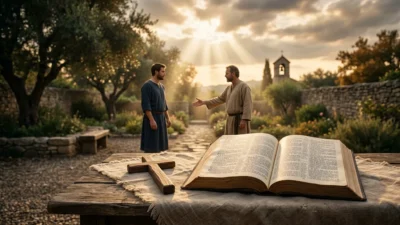
Imagine standing at the entrance of a quiet valley covered in mist. You cannot clearly see what lies beyond, yet you know it represents a journey everyone must one day take.
This image reflects how many people in the Old Testament viewed death.
They knew life would not last forever, but they trusted God even when they did not fully understand what came next.
The Bible uses the word Sheol to describe the realm of the dead in the Old Testament.
Understanding this term helps us better understand God’s plan of salvation and the hope revealed through Jesus Christ.
For Christians, the study of Sheol is not meant to create fear. Instead, it points us toward the greater promise of eternal life. Through Christ’s death and resurrection, believers have confidence that death is not the end.
So, what does Sheol mean in the Bible, and what spiritual lessons can Christians learn from it today?
Let’s explore its biblical meaning and discover the hope God’s Word provides.
Biblical Meaning of Sheol in the Bible
The Sheol meaning in the Bible refers to the realm or place of the dead mentioned throughout the Old Testament. The Hebrew word Sheol generally describes the unseen place where the dead go after death. It is not always presented as a place of punishment, nor is it always identical to the New Testament understanding of hell.
In many Old Testament passages, Sheol simply represents the grave or the place of departed souls.
For example, Psalm 16:10 says:
“For you will not abandon me to Sheol; you will not allow your faithful one to see decay.”
This verse expresses confidence that God has power even over death. In the New Testament, Peter applies this passage to the resurrection of Jesus Christ (Acts 2:27), showing God’s victory over the grave.
Sheol in the Old Testament
The Old Testament often describes Sheol as the destination of both the righteous and the wicked after death.
For example:
- Jacob expected to go to Sheol after his death (Genesis 37:35).
- Job spoke about Sheol during his suffering (Job 14:13).
- David mentioned Sheol in several Psalms while expressing trust in God.
These passages show that Sheol was understood as the realm of the dead rather than simply a place of eternal punishment.
Is Sheol the Same as Hell?
Many people confuse Sheol with hell.
While some English Bible translations use the word hell for Sheol, the two terms are not exactly the same.
In the New Testament, words such as Hades and Gehenna describe different concepts related to the afterlife and final judgment.
For Christians, the most important truth is that Jesus has authority over death itself.
Jesus Defeated Death
The greatest hope of the Bible is not found in Sheol but in Christ’s resurrection.
Jesus declared in John 11:25:
“I am the resurrection and the life. The one who believes in me, even if he dies, will live.”
Through His death and resurrection, Jesus conquered death and opened the way to eternal life for everyone who believes in Him.
The Hope of Eternal Life
The Bible teaches that believers do not need to fear death because of God’s promises.
Romans 6:23 says:
“For the wages of sin is death, but the gift of God is eternal life in Christ Jesus our Lord.
This promise shifts the focus from fear to hope.
Death is no longer the final word.
Because of Jesus, eternal life awaits those who trust Him.
God’s Victory Over the Grave
The sheol meaning in the Bible ultimately points beyond the grave to God’s power over death.
His plan has always been to bring life where there was death and hope where there was fear.
Christ’s resurrection fulfills that promise.
Spiritual Significance and Symbolism
The sheol meaning in the Bible reminds believers that earthly life is temporary but God’s promises are eternal.
Sheol symbolizes the reality of death and humanity’s need for God’s saving grace.
It also reminds Christians that true hope is found not in avoiding death but in trusting Jesus Christ.
Think about someone walking through a dark tunnel.
The tunnel is real, but it is not the final destination.
At the end shines bright light.
For believers, Christ is that light.
He leads His followers beyond death into eternal life.
Sheol also encourages Christians to value each day God gives them.
Instead of living in fear, believers are called to:
- Trust God’s promises
- Share the gospel
- Grow in faith
- Love others
- Remain faithful
- Live with eternal hope
God’s love reaches beyond the grave through Jesus Christ.
Biblical Interpretations in Dreams or Real Life
Some people dream about graves, dark valleys, cemeteries, or loved ones who have passed away.
These dreams should not automatically be viewed as direct messages from God or predictions about the future.
Instead, they often reflect personal emotions, grief, or a desire for spiritual reassurance.
A dream about emerging from darkness into light may symbolize renewed hope, spiritual growth, or trust in God’s promises.
A dream about fear or death may encourage someone to seek comfort through prayer and Scripture rather than fear.
In everyday life, the message of Sheol reminds believers that life is precious and eternity matters.
God lovingly invites everyone to place their faith in Christ and receive the hope of everlasting life.
Practical Lessons & Faith Insights
The sheol meaning in the Bible reminds believers that death is not the end for those who trust in Jesus Christ. Live each day with faith, spend time in God’s Word, and share His hope with others. God’s promises are stronger than death, and His love offers eternal security through Christ.
Conclusion
The sheol meaning in the Bible helps us understand how the Old Testament described the realm of the dead while pointing forward to the greater hope found in Jesus Christ. Through His resurrection, Christ defeated death and opened the way to eternal life for all who believe. Instead of living in fear, believers can walk with confidence, knowing that God’s love and promises extend beyond the grave into everlasting life.

Bret Lee is a dedicated Bible writer and Scripture researcher at Bibliaxs.com, passionate about exploring biblical meanings, Christian teachings, and spiritual wisdom. He creates insightful content that helps readers deepen their understanding of God’s Word and strengthen their faith.